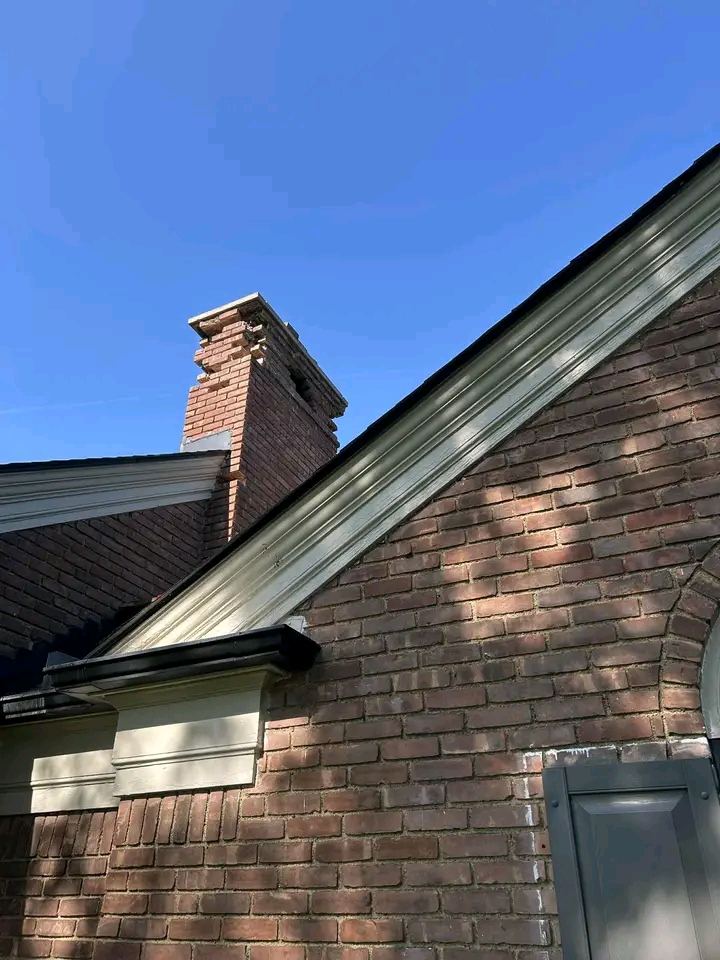
As masons who've worked on thousands of chimneys across Cleveland's west side, we can tell you that one of the hardest conversations we have is telling a homeowner their chimney can't be repaired — it needs to be rebuilt. Nobody wants to hear that. But catching a rebuild early actually saves money compared to patching a chimney that's past the point of no return.
Here are the seven signs we look for during inspections that tell us a chimney needs rebuilding, not just repair.
1. More Than 50% of Mortar Joints Are Deteriorated
When we inspect a chimney, we look at the overall percentage of mortar joints that are eroded, cracked, or missing. If more than half the joints are compromised, tuckpointing becomes a temporary fix at best. The remaining "good" mortar is likely close behind, and you'll be paying for tuckpointing again in 2-3 years. A rebuild gives you 50+ years of solid masonry.
2. Bricks Are Spalling (Faces Popping Off)
Spalling happens when water gets inside the brick, freezes, and blows the face off. If you see bricks with their front surfaces flaking, crumbling, or missing entirely, the bricks themselves are failing — not just the mortar. You can't tuckpoint around bad bricks. They need to be replaced, and if spalling is widespread, a rebuild is the most cost-effective solution.
3. The Chimney Is Leaning
Any visible lean — even a slight one — indicates a structural problem below the surface. This could be foundation settling, deteriorated mortar throughout the structure, or water damage to the internal support. A leaning chimney is a safety hazard and almost always requires a rebuild from the point of failure upward.
4. You Can Pull Bricks Out by Hand
This is the test that shocks most homeowners. If you can wiggle or pull a brick out of your chimney with your bare hands, the mortar has completely failed in that area. When mortar deteriorates to this point, the chimney is essentially a stack of loose bricks held together by gravity and habit. This is a rebuild situation.
5. Previous Repairs Keep Failing
If you've had your chimney tuckpointed or patched in the last 3-5 years and the repairs are already failing, the underlying structure is too far gone for surface repairs. We see this often in Parma and Lakewood homes built in the 1940s-1960s — the original soft mortar has deteriorated throughout, and patching the surface doesn't address the deeper problem.
6. Interior Water Damage Near the Chimney
Water stains on the ceiling or walls near your chimney, musty smells, or actual dripping during rain all indicate that water is penetrating through the chimney structure — not just at the cap or flashing. When water is coming through the masonry itself, the brick and mortar have lost their ability to shed water, and a rebuild is usually necessary.
7. The Crown Is Completely Destroyed
The chimney crown is the concrete cap on top that seals the gap between the flue and the outer bricks. If the crown is missing large chunks, has deep cracks, or has separated from the bricks entirely, water has been pouring into the chimney structure for years. By the time the crown is this far gone, the damage below it is usually extensive enough to warrant a rebuild.
What Does a Chimney Rebuild Involve?
A typical chimney rebuild involves tearing down the chimney to a sound point (usually the roofline) and reconstructing it with new brick, mortar, flue liner, crown, cap, and flashing. Most rebuilds take 2-4 days and cost $3,000-$8,000 depending on size and complexity.
Five Star handles the entire process including permits, debris removal, and matching your existing brick color and style. We serve Parma, Lakewood, Rocky River, Westlake, Bay Village, Fairview Park, North Olmsted, and all of Cleveland's west side. Call 216-468-4864 for a free chimney inspection.